Showing posts with label Architecture. Show all posts

Saturday, August 11, 2012

Olympic Dreams in Landscape Architecture


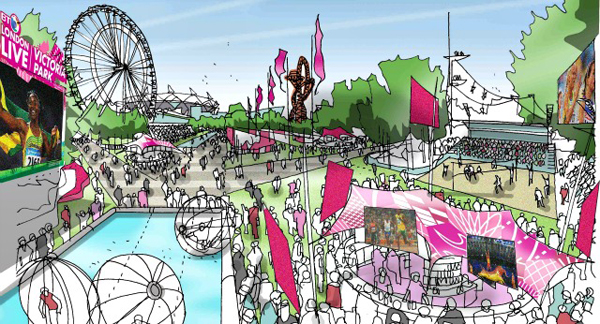
Victoria park, London, the site of great Olympic celebration, ruined by an over cautious state and uncooperative nature of the London weather. Part of the difficulty in hosting the Olympics in a large international city is the issue of finding enough space to place all the things required for a successful event. This years Olympics will not be seen as a failure, but it has failed, perhaps by no fault of the organizing party, to create an Olympic atmosphere.


For me, London eerily lacks the constant noise and excitement of this once in four years spectacle. This world scale event seems to have not injected anything into a city with already so much going on. The Olympics is reduced to a hiccup in a routine. 

This is the first Olympics to be available at a high quality over the internet. The BBC does an incredible job with streaming radio and video coverage. Coverage so good, that it's better than the flickering screens in these event parks. With the London weather being what it is, it is much more preferable to be at home, cold beer in hand, watching whichever and whatever event one's heart desires. 

The difficulty of creating this event space is absolute lack of need for the place itself. Between home TV and the internet, the only reason to see the games is to see it in person. There is no true incentive to go to a damp crowdless park, have to go through airport style security, and buy nine pound beers. Technology has become so good at connecting us to the events themselves that event spaces that don't host the competitions themselves are no longer necessary in a nation where everyone's phone is a portal to the games. 

Bonus Olympics fireworks


Sunday, July 15, 2012

Everything to Say


It is sometimes easy to forget that architecture is the most primitive
and universal language. The primal need for shelter evolved into the
complex system of schools of thought, arguments in theory, and a
general audacity in our view of what architecture is and what we
create in this world.


Monday, July 9, 2012

The Little Blue House on Royal Street

 On the way from Kings Cross station to Camden town, there is a peculiar building in the midst of row after row of British town houses. It is easy to miss if you aren't looking for it, but when you do, its hard not to take a moment and stare at the blue marble facade. This hidden gem is apparently the new offices of the British architecture office Patel Taylor. Although not listed at their own website, other internet listings seem to point it to them.


Friday, July 9, 2010

China Pavilion: The metaphor


IMG_4028.jpg


I mentioned previously that the China Pavilion is a surprisingly good metaphor for what China is going through now as a nation. After being in Shanghai (one of China's fastest growing and most international cities) for two months, China has revealed itself to be a proud nation who is extremely concerned with how it is perceived by the international community. However, due to rapid growth, the general Chinese population has not been able to catch up. What one ends up with is an exterior that looks half polished while the interior is glaringly flawed.
Before I continue my rant on everything that disappoints me about this aspect of China and become seen as a merciless traitor to my birthplace, here a few words that will hopefully save me from being deemed so. First and foremost, I love this country, it's food, it's people, and it's environments have given me fond memories to carry through my life. One of the saddest moments of my life was boarding that plane to New York when I was eight, knowing that being Chinese will mean something completely different from then on. Each time I come back, I've had mixed feelings about what I feel. On one hand, I still see the memories of everything I know and love and continue to find new surprises that secure China's prominence in my heart. However, time after time I find my self disgusted with certain ways this country has developed in the past twelve years. It seems that for each building that rises in China that I love, hundreds are built that I hate. This failure is an embarrassment to the reputation China is fighting so hard to build. The China pavilion arrives at a perfect time when I just can no longer look on and not be furious.

Thursday, July 8, 2010

The art of Architectural Lighting


This past Wednesday I attended a seminar by Harald Hofmann of the Leox Design Partnership based in Germany. They do lighting design for architectural projects. They don't design the lights themselves, but rather uses them to create an environment or an effect that brings out another dimension in the architecture. The seminar provided a insightful look into the impact of light design and what the future holds for this medium.
 
Modern architectural lighting design started with Richard Kelly in the 1950s. The three pillars of light design as defined by him is; to support Function (for the comfort of the program of the space), to Reveal interior or Exterior elements (that maybe otherwise not highlighted by natural light), and to be Integrated with architecture (as a part of and not an addition to). Hofmann goes on to use two very familiar projects as an example. I.M.Pei's Louvre addition, and Allianz Arena by Herzog and de Meuron. In both these projects, artificial lighting is essential to the iconic presence these projects have in our minds.

Monday, June 28, 2010

Difference in Communication


This recent post on Boing Boing really caught my attention; largely due to the frustration I face interning in a multi-lingual environment. However, the communicating differences between languages has become an increasingly big area of interest for me. As someone who has taken an introductory class in linguistics, albeit pass/fail and not one of the classes I am not most focused in (a euphemism for skipping class), languages are one of the most fundamental things that factor into the way we think. Although we may not realize it, our native language already factors greatly in the way we process what we sense, and how we discuss it. 

For architecture this becomes increasingly important. As I have realized in my architectural studies, subtle meanings in seemingly similar words can be the cause of miserable miscommunication. As architecture becomes an increasingly international field, the communication barrier is not only a conscious problem, but also a subconscious dilemma.  

Saturday, June 26, 2010

Bjarke Bikes


XPO - BJARKE BIKES THROUGH DANISH PAVILION from BIG on Vimeo.

Horrible pun aside, heres a video of Bjarke riding through the Danish Pavilion and almost running some people over.

Tuesday, June 22, 2010

This is perfect for getting through the recession

Call him what you like, an architectural prophet, and evil genius, a guy with the best name for an architect ever. Yet despite what one may think of his work or designs, Rem Koolhaas is without a doubt, one of the most successful and influential architects of the last 30-plus years. In my experience, architecture students are some of his biggest fans, a group that recently has begun to include Sultans, Presidents, and Brad Pitts of the world. After interviewing the man himself, the Independent recently published an article discussing among other things, how Koolhaas has been able to stay afloat and fresh while the world's capital has dried up. It is certainly worth a read and it offers a fresh perspective on what it means to be a successful architect. And for the students out there, even if you already knew about his swimming habits, the article gives some more interesting glimpses into the life of the legend that is Rem.

Read the article here (fixed)

Oddly Architectural Moments

Oddly Architectural
This past Sunday I came across something that struck me as somewhat architectural. The more I thought about it, the more interesting it became. What really struck me is the fact that it seems to be supersaturated, yet somehow contained, built over time by the hands of many customers.

Oddly Architectural

Friday, June 18, 2010

RawrBooks: The Function of Form by Farshid Moussavi

The Function of Form

Yes Is More by BIG started me on a reading binge for architecture books, but The Function of Form is one book I will always keep by my side. One part reference, one part structures guide, and one part picture book, the Function of Form provides an insightful view into structure and spaces they create. 

Thursday, June 17, 2010

David Byrne: How Architecture Helped Music Evolve


Architecture today goes beyond just putting roofs over people's heads and erecting walls to keep the weather out; architecture becomes a culmination of multiple conceptual and real-world ideas. David Byrne presents music as one of those things. He walks through the evolution of music and attributes its change to the shifting environments music is played under. It's worth a look.

Saturday, June 5, 2010

You must be this tall to ride: Kengo Kuma's talk

From the Kego Kuma talk

A bunch of us went to go see Kengo Kuma talk today. It was a lackluster speech, but mostly due to the lackluster translation. I'm sure if I were fluent in Japanese, the talk would be a lot more exciting. However, I did leave the talk with some things to think about. The most intriguing aspect of the talk was the importance placed on the relationship between man and the environment and man and history. Architecture serves as a intermediate language between the two. Kuma believes that architecture should not just flatten its surroundings but play a harmonious if not subservient role. Kuma displays this through his work, either placing the architecture in such a way that it becomes a frame for the surrounding beauty, or using local materials that bridge the gaps between the old and the new. That pretty much summarizes my notes, his work is definitely worth checking out.
Follow this Link

Monday, May 31, 2010

Building your Architectural Library

It seems we've been told since nearly the beginning of our architectural education of the extremely important concept of building our architectural library. I actually do have a good number of architecture books, but most of them are gifts from aunts and uncles who don't really know what a good book is for an architecture student. Therefore, my architectural library mainly consists of general architectural history books with a handful of Frank Lloyd Wright books and bios sprinkled here and there. It's not that I don't appreciate those books and don't enjoy thumbing through them, it's just that it kind of feels like receiving a subscription of Architectural Digest for your birthday instead of Architectural Record. Inspired by the Barnes and Noble giftcard I found in my wallet and the prospect of returning my second copy of 101 Things I Learned in Architecture School (both had been gifts) for some store credit, I set off in hopes of expanding my architectural library with a book or two more relevant to my studies than the secret life of FLW.

I eventually found the architecture section, and realized I had been quite naive in my hopes of finding something along the lines of Vers une architecture or Delirious New York. There were only about 6 ft worth of architecture books, and even more sad was that these were mixed in with the interior design books. Really, the majority of the books in that section seemed to be about home improvement. After much sifting I eventually settled on two purchases: The Architecture of Happiness and From Bauhaus to Our House. The former is about the philosophy of the importance of our architectural environment on our personal psyche and the latter is a critical satire on modern architecture. Neither is written by a big name in the architecture world, and I seriously doubt either is on the list of recommended books given to us by our freshmen studio profs, but I look forward to reading them nonetheless and hope to gain some unconventional architectural wisdom.

Friday, May 28, 2010

Paris in Review: Sainte-Chapelle


IMG_0381
Well this seems redundant, but I guess this will be for those too lazy to rummage through the images themselves or those who like the sound of my sweet written narration. Anyway, onward.
One of my favorite places was Sainte-Chapelle. Here is a Wikipedia brief to prepare you for my comments after the break.


"The Sainte-Chapelle, the palatine chapel in the courtyard of the royal palace on the Île de la Cité, was built to house precious relics: Christ's crown of thorns, theImage of Edessa and thirty other relics of Christ that had been in the possession of Louis IX since August 1239, when it arrived from Venice in the hands of two Dominican friars. Unlike many devout aristocrats who stole relics, the saintly Louis bought his precious relics of the Passion, purchased from the Latin emperor at Constantinople, Baldwin II, for the exorbitant sum of 135,000 livres, which was paid to the Venetians, to whom it had been pawned. The entire chapel, by contrast, cost 40,000 livres to build and until it was complete the relics were housed at chapels at the Château de Vincennes and a specially-built chapel at the Château de Saint-Germain-en-Laye. In 1241, a piece of the True Cross was added, and other relics. Thus the building in Paris, consecrated 26 April 1248, was like a precious reliquary: even the stonework was painted, with medallions of saints and martyrs in the quatrefoils of the dado arcade, which was hung with rich textiles"

Remember Paris?

IMG_0345
I know it has taken a while, but I've finally found a home for the stupendous amounts of photos I've taken.
Here is the flickr link. It's not fully on there, Days 1-4 are on right now, I will try my best to put them all up there in a jiffy.

Wednesday, May 26, 2010

Shanghai EXPO! Danish Belgian and UK(ish?)

I don't think it needs much explaining, so here are a bunch of pictures.

Tuesday, May 25, 2010

The Need for LEED


Frank Gehry recently had some controversial opinions regarding LEED (Leadership in Energy and Environmental Design, a system for rating buildings on their "greenness") . Gehry is quoted as saying in reference to LEED, "I think the issue is finally a political one...a lot of LEED is given for bogus stuff." This seemed to have caused tremendous unrest in the heart of Susan Szenasy, who wrote a letter titled "you are so wrong, Frank Gehry", in which she writes:

"With buildings known to produce more than half of the world's carbon output, surely those who design and build them have to shoulder some responsibility. But not, apparently, Gehry. He cavalierly called out LEED ratings (and thus the many efforts made every day by architects and designers to make our world less toxic, use available energy and water more carefully, pay mind to the site and its proximity to public transit, etc. ) as 'political' and 'bogus.' This is unfortunate for everyone concerned, and everyone must be concerned. But I'm not surprised, though I am saddened no end."

Fred Bernstein architecture writer and critic countered Szenasy with the following

"One example is CityCenter, the Las Vegas complex that contains more than 5,000 hotel rooms, plus casinos and shopping malls and restaurants and nightclubs - altogether, 18 million air-conditioned square feet smack in the middle of the Mojave Desert. I can't imagine a greater environmental disaster than this complex (which, in addition to requiring vast resources to build and operate, is designed to draw travelers from around the world). And yet it was awarded LEED Gold status." 


Building Comedy

Almost all forms of art have a comedic genre, yet such a category doesn't really pop-out in the world of architecture.  However, I've started to think about this quite a bit.  First, can architecture be funny.  Secondly, if so, should it be.  I think it's fair to describe goal of architecture, at least in one way, as the pursuit of improving the human condition through our built environment.  Now it has been shown that laughing causes people to live happier and healthier lives, but should we be content with our diet of laughs coming from the things and people like youtube, Judd Apatow, and Flight of the Conchords, or should our buildings help crack a smile too.

Monday, May 3, 2010

Arty

To perfect to pass up for RAWRchitecture, dinosaurs in architectural landscapes. Not to mention how inherently architectural dealing with issues of scale, representation, and photography vs drawing is. More at Original link: http://www.flickr.com/photos/benheine/sets/72157623723956821/


Images by Ben Heine


Tuesday, March 9, 2010

paris post: spirals stairs


Getting off the plane in Paris, one of the first things I noticed in the airport was the spiral staircase. From what it seems to me, the spiral staircase is something seen more in Europe than here in the states. The spiral itself is beautiful in form. From the bottom step to the top, there is a continuity of motion missing in switchback stairs. Like the Parisian roundabout, the spiral stairs solve the issue of circulation, but on a human scale.On a multistory spiral staircase, each landing diverts motion but does not pause it. Like a roundabout, cars getting out on each street does not stem the flow of the roundabout itself.


Inside a house facing a covered walkway
Charles de Gaulle airport


While many spiral staircases have beautiful sweeping curves and a dizzying central atrium, others show the versatility of the style. In the chapels and cathedrals of Paris, spiral staircases are fit into the tightest of places. When moving into the staircases, one feels the space getting squeeze down. In one moment you are in a space large enough to fit a twenty story building, then your cramped into a space where you cannot even throw up your arms without knocking into something. Instead of an atrium alluding to the size of stair, the stairs seems to suck itself into a singularity. You don't know when they end because you can't see when they end.  


Inside Sainte Chapelle


At the end of these tight staircases, the space you stumble out onto seems all the larger. After being squeezed for a disorienting amount of time, one's eyes dart straight up, sizing up the full volume of the new space. This contrast highlights the extremes of volume in the two spaces. Moving from one to the other, feelings of elevation and claustrophobia is increased by this juxtaposition.  
Stairs are always intriguing to see. They serve the need of vertical movement while at the same time become something decorative and inviting. Where as some are purely utilitarian, many are designed to go far beyond that. Like the designer chair, the designed staircase elevates something in its essence is a tool into an object of beauty and elegance.