I have slowly come to the realize, especially this year, that my lack of knowledge about how software works puts seriously limitations on what I am able to create. Architecture is becoming increasingly reliant on computers. While it does open up a tremendous range of opportunities for design, it also warps ones ability to design because of limitations on skill and understanding of the software itself.
Frustrations with design software happens frequently and often inexplicably. I find anger building while sitting in front of an inanimate screen, forming a hatred so deep that a thousand digital deaths would not quell wildfire that burns in my irises. Yet, I have no one to be angry at but myself. AutoCAD does not begin the day with the sole purpose of destroying my fleeting happiness with life, it hums to life (frustratingly slow of course) and opens itself to record and aid in my design goals. For AutoCAD does not think, it just does, and anything that goes "wrong" is probably entirely my own fault.
So why have I decided that life cannot go on without learning the computer's perspective? Simple answer is that I have a lot of free time on my hands. Free time, once a luxury seen between the end of studio Friday and dragging my hungover face in on Sunday afternoon, has become abundant. Between sessions of Teamfortress and DOTA (neither of which are very helpful to increasing my worth to the world) I've somewhat disciplined myself to learn in small spurts that hopefully over the course of this year yields some results.
The long answer is that I don't want to be limited by what I know how to do. Scripting and parametrics are something I've always wanted to do, not because it is cool and I can change how many louvres there are with a number slider, but because it opens up the possibility of layering increasingly complex elements into my design. The learning curve has been tremendous because of my lack of knowledge of post algebra math and basic computer logic. Now having the unrestrained free time to push over the barrier, I've realized that it is not as simple as watching tutorials and getting it. It seems to require a reset in my frame of mind and an unfamiliar approach to problem solving. I could easily spend another four years of my life in school to achieve the level of mastery required. So what I'm left with is trying to break the surface of a vast ocean of knowledge that is completely overwhelming.
Well, here's to hoping for breakthroughs.

Monday, October 8, 2012


Saturday, August 11, 2012
Olympic Dreams in Landscape Architecture
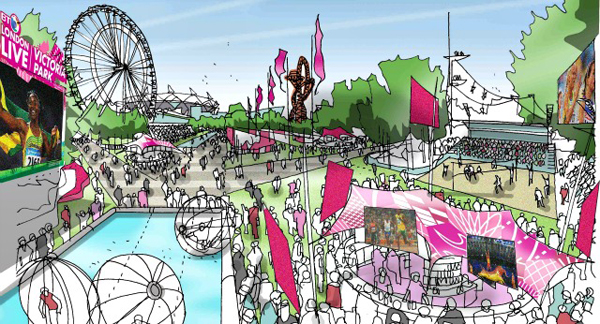
Victoria park, London, the site of great Olympic celebration, ruined by an over cautious state and uncooperative nature of the London weather. Part of the difficulty in hosting the Olympics in a large international city is the issue of finding enough space to place all the things required for a successful event. This years Olympics will not be seen as a failure, but it has failed, perhaps by no fault of the organizing party, to create an Olympic atmosphere.

For me, London eerily lacks the constant noise and excitement of this once in four years spectacle. This world scale event seems to have not injected anything into a city with already so much going on. The Olympics is reduced to a hiccup in a routine.

This is the first Olympics to be available at a high quality over the internet. The BBC does an incredible job with streaming radio and video coverage. Coverage so good, that it's better than the flickering screens in these event parks. With the London weather being what it is, it is much more preferable to be at home, cold beer in hand, watching whichever and whatever event one's heart desires.

The difficulty of creating this event space is absolute lack of need for the place itself. Between home TV and the internet, the only reason to see the games is to see it in person. There is no true incentive to go to a damp crowdless park, have to go through airport style security, and buy nine pound beers. Technology has become so good at connecting us to the events themselves that event spaces that don't host the competitions themselves are no longer necessary in a nation where everyone's phone is a portal to the games.
Bonus Olympics fireworks

Sunday, July 15, 2012
Everything to Say

It is sometimes easy to forget that architecture is the most primitive
and universal language. The primal need for shelter evolved into the
complex system of schools of thought, arguments in theory, and a
general audacity in our view of what architecture is and what we
create in this world.
Monday, July 9, 2012
The Little Blue House on Royal Street


Thursday, July 5, 2012
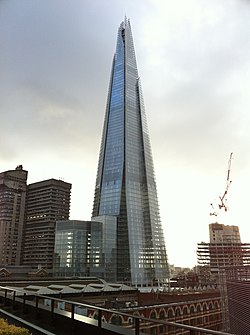
Doing some heavy overtime at work, but the "Shard" by Renzo Piano opens tonight in London with a laser show. Check it out at the link below! It starts nowish...
http://the-shard.com/inauguration/
Whats odd is that the interior is not open... so they are just having a laser show for the completion of the top.
Thursday, June 21, 2012
Mind Blowing Game Changer - The Canon Mixed Reality System
 |
| via Cannon.com |
Architectural design has always been tied down to an imagined reality, where a constant awareness of scalar differences is key to interpreting what is drawn. Drawings, models, renderings all show a perceived reality that one can only grasp through imagination. The full scale implications of building can only be fully appreciated after completion. Representation is important because it assists in bridging that gap. 3D computer modeling has become integral not only as the nexus from which other representative forms are generated, but more importantly as a versatile tool to quickly preview our every design whim. With it, architecture has become quicker, bigger, and more complex.
MR technology is the first step in what I believe to be the next leap in architecture design. As processors continue to evolve in line with Moore's law, it won't be long until visualization becomes less an issue of computing power, but more about what operating framework from which design occurs. MR presents the opportunity to immerse ourselves in our visions, to look at designs through lenses previously unavailable. It allows for incredible scalar transitions. Imagine looking at an animated master plan hundreds of blocks in area on your meeting room table, playing around with buildings and roads like lego blocks. Then transitioning to standing in a room within that plan, looking out your window as CG cars stream by below, making sure your vision remains intact at all scales.
It can also be used to playout some Godzilla fantasies, if that's more up your alley.
Saturday, June 16, 2012
Rawrchitecture, Rawrbooted

For me, the notion of a reboot applies to more than just this blog. It is starting new in a different country and an unfamiliar place, save only for a common language. I first experienced this last night, when lugging the bare requirements of my year around from Heathrow airport via tube to Kings Cross. Then finding the apartment I had found online and secured over Skype in the midst of London's drunkest young people with no way of contacting anyone.
I hope this experience will be mild compared to what this year will have in store for me. I want to realign the focus of this blog into something more personal, an authentic look through our eyes into the experiences brought on by our good fortune being students of architecture. Look forward to posts revisiting experiences in the past four years we've been too preoccupied to post, updates on what we are going through this year, and perhaps a few passionate ramblings brought about by a few too many beers.
Friday, June 24, 2011
Rawrchitecture is Melbourne bound!

We've been keeping quite busy since I've last updated. We applied and got accepted into another exciting 72hour competition. This time it's in Melbourne! Hosted by our friends at OUTR, the Urban Realities competition will follow a similar format to the one we competed in in Israel. In 72 hours, our team would have to design and build something that responds to the prompt and site that we are given. I'll update soon, but I can't promise anything.
Friday, April 1, 2011
Sleep[SHED] 2.0 (Call for Submissions)

Hey All,
I'm sure you all have seen the posters up, but I just wanted to urge you all to take advantage of the special Submission date for Sleep[SHED] 2.0. There will be time to get your submission together during charette and jury week, but it never hurts to start sleeping early. If you have questions regarding content always feel free to contact Drowsy or Sleepy at SleepShed@gmail.com.
Sleep[SHED] 2.0 Submissions due May 2th.
Thanks,
Sleep[SHED] Editorial Board
I'm sure you all have seen the posters up, but I just wanted to urge you all to take advantage of the special Submission date for Sleep[SHED] 2.0. There will be time to get your submission together during charette and jury week, but it never hurts to start sleeping early. If you have questions regarding content always feel free to contact Drowsy or Sleepy at SleepShed@gmail.com.
Sleep[SHED] 2.0 Submissions due May 2th.
Thanks,
Sleep[SHED] Editorial Board
Monday, January 3, 2011
Friday, December 24, 2010
Interactive Surface: Tron Premiere Halfpipe
Tron Legacy Premiere - A Light Session from ENESS on Vimeo.
Interactive surfaces are a new and exciting frontier for architecture. For the premiere of the new Tron movie, a half pipe was created with various lighting effects as a promotion. ENESS did quite a few amazing projects that almost completely transform the materiality and atmosphere of surfaces and objects.
ENESS 2010 Showreel from ENESS on Vimeo.
The interactivity of these projections adds a dimension to architecture that rarely existed before. The previous notion of an immobile surface is redefined as something provocative and curious. By interacting with these interactive surfaces, the audience also indirectly interact with each other, bringing a social element to the architecture.
Monday, December 20, 2010
Super Specific: Shohei Shigamatsu
Shohei Shigematsu, partner at OMA and director of the firm's New York office, recently gave a lecture at the independently organised TEDxEast conference in New York. Entitled "Super Specific", the talk aims at stablising the practice of global architecture within the ever-fluctuating world economy.
I mainly found the talk worthwhile for two reasons. For one, it gives a little insight into how to function as an architect and designer when the economy falters and the going gets tough. In the case of Shigematsu, his designs begin to embrace the hyper-functionalism for which OMA has become well known for and maximise development potential (i.e. money making ability) without sacrificing formal and iconic expression.
Secondly, the short talk is aimed at non-architects. Recently, (probably in large part due to the faltering economy) architecture has come under criticism for being too insular. It's always interesting to see how high-profile architects attempt to engage people outside of the discipline, and it is evident that through his work and oratory, Shigematsu is able to do so rather convincingly.
Also, thumbs up for being the first architect I know to bash MUJI.
Sunday, December 19, 2010
Dinosaur Super Heroes

There hasn't been a dinosaur related post in a while, so I was quite excited when I saw this.
From
http://legitimusmaximus.tumblr.com
Other incredible illustrations along with more dinosaur superheroes at http://www.flickr.com/photos/cadencejunkie/
Wednesday, December 15, 2010
On Line: Drawing Through the Twentieth Century

Architectural representation often deals with issues of the line. At its simplest inception, a line is what connects two points. However, The nature of the line and its effects becomes something infinitely complex. In architecture, the crucial moment is when a two dimensional drawing becomes a representation of a three dimensional idea. How exactly this happens and how clearly the idea becomes interpreted walks the line between science and art; the perception of the viewers versus the medium of the artist.
"On Line" is the title of a series of exhibits and performances happening at the Museum of Modern Art in New York through February 7th. I will post an update as soon as I get a chance to visit. For now, here s a synopsis from the website:
"On Line is organized chronologically in three sections: Surface Tension, featuring the artistic drive to construct and represent movement through line within the flat picture plane; Line Extension, composed of works in which lines extend beyond flatness into real space—that is, into social space; and Confluence, presenting works in which line and background are fused, giving greater significance to the space between lines. In following the development of the meaning of line over the last one hundred years, the exhibition traces it in movement, across disciplines, and as it has been drawn out and rewoven in time and space—inevitably reflecting the interconnection and interdependency that are increasingly both shaping and emerging from a globalized society. Line, like thought, once understood as linear and progressive, has evolved into a kind of network: fluid, simultaneous, indefinite, and open."
The videos synopsis by the artists discuss some very crucial ideas on the ever important line. You can find these videos here: OnLine
Thursday, December 9, 2010
101 Things I Didn’t Learn in Architecture School
Archdaily recently published a list of the "101 Things I Didn't Learn in Architecture School", which will instantly humour anyone who has spent a night in the studio. While you can find the full list here, I'd like to highlight a few of my favourites.
3] Do not drink at work and especially do not get toasted around your colleagues under any circumstances.
14] Go home to your family.
(As I've learned, iPhone's can be used to remind you to do this.)
19] Do not, however, ask for two monitors. Even though it makes you look like a bad-ass you will be expected to do twice the amount of work.
43] If you are invited to be on a jury, don’t trash the student just to make yourself look good or to contradict a rival on the jury. Be constructive and try to help the student. This is the point.
47] Don’t be a Typhoid Mary. When sick, stay home.
62] Architects who do not build things also have important things to say and should be listened to.
67] Read Rem Koolhaas, but do not obsess and fantasize about being him. Delirious New York is still relevant.
82] Always back up your hard drive.
(instructions)
98] Architecture is cliquish.
3] Do not drink at work and especially do not get toasted around your colleagues under any circumstances.
14] Go home to your family.
(As I've learned, iPhone's can be used to remind you to do this.)
19] Do not, however, ask for two monitors. Even though it makes you look like a bad-ass you will be expected to do twice the amount of work.
43] If you are invited to be on a jury, don’t trash the student just to make yourself look good or to contradict a rival on the jury. Be constructive and try to help the student. This is the point.
47] Don’t be a Typhoid Mary. When sick, stay home.
62] Architects who do not build things also have important things to say and should be listened to.
67] Read Rem Koolhaas, but do not obsess and fantasize about being him. Delirious New York is still relevant.
82] Always back up your hard drive.
(instructions)
98] Architecture is cliquish.
Monday, November 15, 2010
Thursday, November 11, 2010
Those Lego Lovers Who Didn't Become Architecture Students
AFOL A Blocumentary from AFOL on Vimeo.
Admittedly, when I was younger, I was obsessed with building with LEGOs. Although I can't say that it eventually flourished into an intense interest in architecture, it sure as hell was time well spent when I was younger. The video is very amusing. The passion these people have for little plastic bricks is amazing. Highlight at 15:00, the guy makes LEGO cars, but doesn't own his own car. to much money spent on LEGOs? or money well invested in pure awesomeness?
Wednesday, November 3, 2010
Tweenbots and the City
Tweenbots website - by Kacie Kinzer
"Tweenbots are human-dependent robots that navigate the city with the help of pedestrians they encounter. Rolling at a constant speed, in a straight line, Tweenbots have a destination displayed on a flag, and rely on people they meet to read this flag and to aim them in the right direction to reach their goal. "
Tweenbots is very interesting project about the city. Happening in New York (where else?), these robots create a very interesting narrative in a city that is know for its unforgiving inhabitants. Results are surprisingly favorable for the tiny little robot. It would be interesting to GPS track the robot to see its route, but the minimal tech makes this project just that much more elegant.
Monday, October 25, 2010
Code City: Building Code Shenanigans
Despite the pecha kucha ripoff program in the form of "ignite". This guy dishes out the info on some pretty important and alarming things about building codes.
Monday, October 11, 2010
72 Hour Urban Action: Transformers Team
Alex Yuen and I prepared a presentation detailing our trip. Instead of rewriting it, I will just post it here.

Subscribe to:
Posts (Atom)